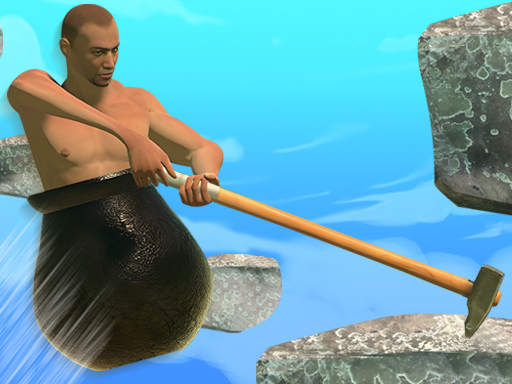
An incremental way to approach the climbing premise when the preserved listing gives only broad control information.
Begin with the movement you can see
Getting Over It Unblocked presents a climbing challenge and describes a character sitting in a large pot. Its supplied controls say Mouse/Touch, while the description stops before explaining the full movement system. The title alone is not enough to infer every mechanic from another game with a similar name. Begin with the instructions and visible response in this particular game.
Choose a small movement and observe what changes. Does the character rise, rotate, slide or remain in place? Look at the result before trying to correct it. Your first useful discovery is the relationship between an input and a visible motion. A narrow observation of that relationship offers a firmer starting point than assuming a familiar gesture will produce a familiar climb.
Choose a nearby reference point
A large ascent can be broken into smaller visual questions without pretending that the game contains checkpoints. Select a nearby feature as a reference and try to understand how your movement relates to it. The reference is a way to compare attempts, not a claim that reaching it will save progress. Keep the next intended movement short enough that you can describe it.
When an attempt goes wrong, watch the recovery too. An immediate succession of corrective inputs can make the original problem hard to identify. If there is time, notice where the character settles and what movement remains available. Sometimes the useful lesson is about avoiding a particular overcorrection rather than repeating the motion that initially gained height. Whether that applies in a given situation depends on the actual controls and terrain.
Use a retry to answer a question
The description emphasizes patience and determination but does not establish how progress is saved, how falls work or whether difficulty options exist. Those are practical details to check in the interface. Do not build a session around an assumed checkpoint or guaranteed recovery that the supplied information never promises. If a break is needed, verify the visible exit or save behavior before relying on it.
For another attempt, name one question: how much input initiates motion, what happens near a particular surface, or which correction made the previous situation worse? Keeping that question small gives you a concrete reason to retry. Progress can then mean understanding one movement more clearly, even before reaching a new height. This is a suggested approach to observation and pacing; it is not a tested route, a completion estimate or a promise that persistence alone will overcome every obstacle.